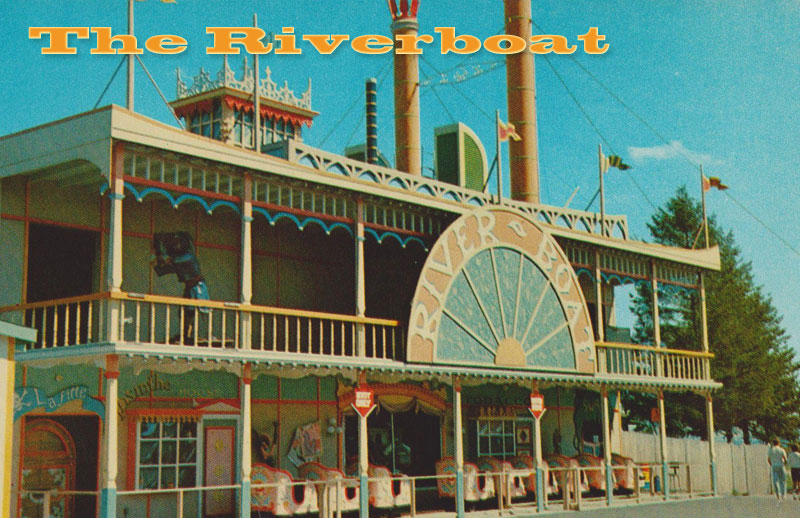
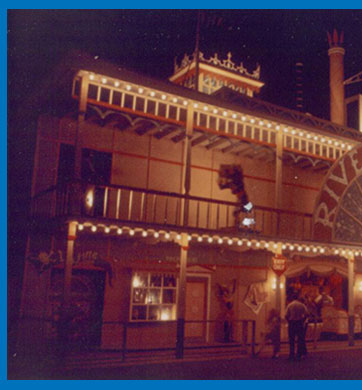
Tracy, the head of Outdoor Dimensional Display Company of North Bergen, New Jersey, pitched Simmons on the old New Orleans dark ride concept; one that would be unique to the
amusement industry. Simmons was impressed and purchased the ride. But the installation project was to be plagued by more problems than any voodoo curse could inflict.
According to Ed Serowik, Crescent Park’s assistant ride manager at the time, the ride’s installation got off to a smooth start. Ed and his crew removed the old pool hall, the bowling alley and R.E. Chambers Rocket Ship ride (originally a Harry Traver Circle Swing) to clear the way for the new dark ride. As a seven-year-old in the late fall of 1961, I recall watching both buildings being torn down. The park wasn’t gated back then, so my grandfather would often take me there during the off-season for a glimpse at new attractions under installation. Recently, I learned from Ed that both buildings were being used as off-season storage for the park’s kiddie rides. Ed also fondly recalled he and his colleague Allie Olsen staging impromptu bowling matches with leftover pins and balls on one of the unobstructed alleys.
In early 1962, I saw what appeared to be a Quonset Hut building being erected on the site. After that, I became busy with school and other activities, and was not able to survey the project any further. I missed out on the fact that the park was salvaging lumber from the park’s recently decommissioned Zephyr roller coaster to construct the Riverboat. I didn’t even know the coaster wasn’t going to reopen in 1962.
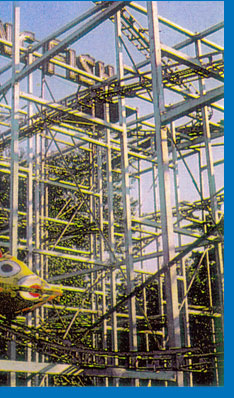
“We built the building to Tracy’s specs.” Serowik recalled. “He told Arthur what size building he needed and we took it from there. We built these beautiful laminated trusses and bolted them as we went along. It was a shame we had to paint them black so nobody could see them inside the ride.”
Shortly after the trusses were in place, the first of many disasters struck.
“There was one weekend that we had a hell of a storm. It took all the trusses down. Poor Arthur…that’s when he first started pulling his hair out.”
After the trusses were put back in place, side walls were installed protected from the elements by corrugated aluminum. A cement floor was poured. Then misfortune reared its ugly head again.
“The cars that came with the ride were like little Model A Fords," Ed recalled. “The track was made out of wood and came with wood slats as to give riders the feel of a bumpy road. But it didn’t work. You couldn’t bend the track properly and the cars wouldn’t make it over the slats. Again, Arthur was pulling his hair out.”
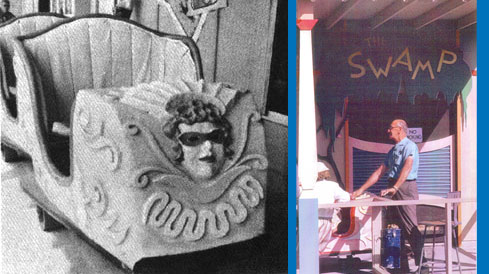
So Simmons called on two icons of the New England amusement park industry, Ed Leis and Dom Spadola, to come to the rescue. Leis, by now a veteran employee of National Amusement Devices, had become a master at rebuilding and repairing amusement devices of all kinds. Spadola was a brilliant designer and artist who worked extensively in the region’s parks. At the time of the Riverboat crisis, both men were on assignment at Holyoke’s former Mountain Park, building the Out of This World funhouse. In 1960, the duo had converted Mountain’s Laff In The Dark Pretzel ride into the two-story Mystery Ride. The Pretzel cars, the classic models with Pretzel logos as side counterweights, were not retained for the Mystery ride and were in storage. The Pretzel cars were trucked to Crescent Park, accompanied by Spadola and Leis. The wooden track was replaced by standard t-rail with an insulated hot rail. Leis converted the Pretzel cars' undercarriage, making it compatible with the new rail. The two steel rear wheels were bonded with polyurethane to roll smoothly on the concrete floor. Spadola completely overhauled the cars’ exteriors, installing colored rubber along the edges, painting them pink and creating celastic masked Mardis Gras faces for the front and back.
“Everything worked pretty well except that the original nylon bolts were used to fasten the track would come lose and short it out if riders rocked the cars.” Ed recalled. “We overcame that by using larger bolts.” So where did those ill-fated antique ride cars originate? To this day it remains a mystery. They weren’t Tracy Hush Puppy models, and while Tracy had a business relationship with the Alan Herschell Company, Serowik claims there’s no way that rolling stock was produced by Herschell. And Ed notes that the original track with the wood slats looked very similar to the track in a Harry Traver/R.E. Chambers dark ride. |